South Junior High Years

Three years of education for grades 7 through 9 will be hard to capture in one blog entry, however, there are significant memories and experiences that ignited “things” in me that I now refer to as passion(s)…I think that sometimes as people who want to truly know and understand who and what makes us the person we are in a moment, we must be brave or curious to go back in time to our memory banks and look at our “deposits”–those things that were put in motion for us as young impressionable teens trying to figure out life, school, and our giftings. Since I began writing about my early years of life, I am beginning to truly see the people and experiences that helped or hindered who I am today. In this entry, I want to focus on some positive moments during the awkward years of being a junior high student.

Meet how Susan and music collided together in 7th grade. Listening to music was part of our enjoyment in the home; my parents had a wide variety of albums that they played on the record player. There was opera, movie soundtracks, and vocalists with styles and names I no longer recall except for Nat King Cole, Tennessee Ernie Ford, Frank Sinatra, Bing Crosby, Burl Ives…. But, what I do remember is that often the TV was turned off and the music was turned up and we enjoyed the sounds coming out of the speakers. There were evenings I watched as my parents danced in front of the fireplace, their feet gliding ever so smoothly and eloquently across the hardwood floor. I would sit on the couch and watch, and then there were the times dad held my hands and as I stood on his stockinged feet, he would glide me across the floor “dancing”. A love for music and the feelings it erupted in me began early in life with those living room seeds, which were watered and fertilized in 7th grade with a mandatory music class. My teacher was Miss Gase, who was young, very poised, perfectly groomed every day and had a no nonsense approach instilling music theory into our young minds. She was also the school’s choir director and because I loved to sing, I joined. Practicing in the classroom or the empty auditorium never bothered me. I was full of joy and confidence until our first performance in front of parents and teachers. My joy and confidence in front of full seats and bright stage lights were exchanged for fear. I was in the front row and to Miss Gase’s left as she began directing our arranged pieces. In the first few stanzas of our initial song, I must have gone white, pale, and I remember feeling flushed with heat and a need to throw up. Ever feel that way and try to escape? I had nowhere to escape unless I wanted to truly be the center of attention at that moment. I tightened my knees, clenched my toes inside my shoes, and hoped whatever was happening would leave soon before making a spectacle of myself. And then it happened. Miss Gase’s eyes made contact with mine. Without losing a movement of her hands that were directing our song, the choir and me singing out parts, she was able to point with her index finger towards the curtains of the stage while mouthing “are you ok?’….giving me a viable alternative to throwing up on the stage….and while that solution was perfect, it still meant I’d draw attention to myself if I suddenly walked off…but something magical happened. In that moment of eye contact with my teacher, I relaxed. The feelings of nausea and being overheated left my body and I was able to nod to her and mouth “I’m ok”. And I was.

I don’t think Miss Gase ever knew what her actions did for me that evening. I know what they did for me. My fears were acknowledged. I was seen. I was assured. I was given a chance to escape my fears. I stayed. I faced my fear and with a loving teacher, I replaced them with a newly learned confidence, one that would serve me well later in life as my love for singing grew and expanded for many audiences, but mainly for God. Thank you, Miss Gase.

Meet Mr. Noble.

As polished and elegant was Miss Gase, Mr. Noble was the opposite. He was an older, more seasoned teacher with a bald spot on the top of his head complimented by fluffy tufts of hair around his ears tinted with salt and pepper. His teaching methods weren’t what we’d call “safe” today (his paddle still hung on a corner of his desk) and the map pointer sometimes became a projectile aimed at a sleepy non-responsive student. Every week in our social studies book looked alike with reading, studying, quizzes and tests, but it was what he did with a blackboard and a piece of chalk that shone a new awareness in me–a love for words. Let me explain.

Every Friday Mr. Noble wrote a rather obscure word on the upper right corner of his chalkboard. When we came to class, it was our responsibility to write the word down in our notebooks and the assignment over the weekend was to find out the meaning of the word and write a complete sentence using it correctly. On Monday, when we came back to class for a new week, it was expected of us to have our research completed. This simple assignment was part of our grade.I wish I could remember all the words or phrases I learned from Mr. Noble in 7th grade social studies class, however, I’m sure those obscure words have and continue to make their way into conversations and written documents that I produce today. One phrase I DO remember is: Caveat emptor . If you don’t know what it means, well, how about you do an investigation, write it in a complete sentence and wait for a time when you can use it correctly when speaking with someone.

Meet Miss Roethke.

Miss Roethke was my 9th grade English teacher. She was another seasoned teacher by the time I was in her class. Tall, gray hair always coiffed, with round black glasses framing her blue eyes, she was serious and stern. She didn’t tolerate nonsense in her classroom either and anytime we were out of control she merely flicked the lights on and off a few times to regain our attention followed up with an admonishment. 

Miss Roethke used the upper right corner of her blackboard for similar practice as Mr. Noble. Each week, she’d write a word and it’s grammatical progression so we’d learn proper grammar. Lie. Lay. Laid.   There. Their. Then. Than. Except. Accept. (those familiar troublesome words!)

We read classic novels. We read poetry. We wrote stories. I loved it all! One of my favorites in her class? Listening. When Miss Roethke read poetry to us it’s a miracle I never fell asleep as her mouth and lips formed each word and phrase that made the lyrics jump off the pages as though dancing. The lilt in her voice was soothing and showed a side of Miss Roethke that was otherwise hidden. 

Another time that she appeared “real” to me was the Friday leading into spring break. Just because we’d be off school for a week didn’t mean we were escaping homework. Our assignment over spring break was to choose and read a book. To hold us accountable, we were required to write down the title and author on a sheet of paper she taped to the windowsill. Before leaving school that Friday, I stayed after my last hour and quietly entered her room. She was seated at her desk, a book in hand and we exchanged brief hellos as I walked past her to the window. With my back to her, as I was entering my information, I heard her ask “Miss Jewell, does your family have any special plans for spring break?” I looked up. I didn’t turn around. For a moment I was in shock. “Miss Roethke just spoke to me!” I pondered…she didn’t talk about our classroom work or a particular issue I may have had regarding  understanding conjugating a verb…she asked me about me and my family…I don’t remember what spring break held for our family that year so my answer was a brief “no, nothing special”. I walked into her classroom on a Friday afternoon feeling very much like an average awkward 9th grade girl, but I left with a new skip and bounce in my step and a smile on my face as I walked the many blocks it took to get home. Miss Roethke saw me. She acknowledged my presence on a quiet Friday afternoon in front of a sunny window. And with one simple question she showed me that in addition to being a stickler for learning proper English and enjoying a variety of literature, she engaged outside of all those requirements assigned to her by letting me see that a teacher would be curious about life outside her classroom.

Music. Words. Reading. Writing. Those and more were and remain vital to my passions. But of greater value from lessons learned in junior high years was “being noticed”. Being acknowledged, those one-on-one moments where a need or love to learn were seen, opened with the discovery of new songs to be sung, new books to read, new words to learn and use. New simple questions to be asked. Those beloved teachers are now long gone from the rooms and halls of South Intermediate Junior High but their instruction, their discipline, their encouragement echo in my memories and spill out into my life with many beautiful memories and lessons for my life as I continue to enjoy the fruits of their labor.

Oh, did I tell you? Miss Roethke was a sister to Theodore Huebner Roethke, a famous poet. It was often that she read his writings to us, lulling us to a place of deep appreciation and relaxation, which is magical when you think of it, a classroom full of snarky 9th grade boys and girls. In those moments, listening to her, we were temporarily transported to another time and place. Thank you, Miss Roethke, for being stern, gracious, and passionate for the English language. 

Lessons from Mom

A mother is the most important person to have in one’s life. After all, without a mother none of us would be here. I will admit early in the writing of this blog that my mother and I had a relationship that encompassed tension, love, grace, being misunderstood, but above all, love, especially in my adult years when I came to my senses and realized my shortcomings that led to hard conversations. Make no mistake, I loved my mom dearly and learned so much from her. I’d like to tell you about her.

Ida was the baby in her family of six children. My grandparents were German and had immigrated to America in the early 1900s. For her formative years, German was her primary language although English was learned alongside which prepared mom for her parochial education through the 8th grade at the Lutheran church the family attended. Compared to most families living in the 30s and 40s, theirs was of modest income which meant food, shelter, and needs were always met. My Grandpa Hillert worked on trains, grandma was home with the children.

I loved hearing stories about my grandparents whom  I did not have the privilege of knowing before I was born. I heard about how grandpa did all the “marketing”….that grandma spoke very little English and how mom and her sister Emma would go to a movie, come home and act out the plot to their mother, all in German, sitting in the parlour. I was told about Christmas seasons where my grandparents spoke about gifts to be purchased, using Russian or Polish to keep secrets from the children, how mom and Emma would grab hold of a few of those words, run across the street to the neighbor to have them “interpret” the words, but to no avail; they were unable to remember how to pronounce what they’d overheard.

Mom was a good 3 years younger than my dad when they met. Dad and his brother Lyle moved to Saginaw to get jobs in a plant. This was World War II time and Uncle Lyle had met his future wife, Dorothy, whose best friend was Ida. A blind date was arranged between dad and Ida. I don’t recall what the evening held, most likely a movie, but it wasn’t exactly the most exciting time for either of them. As mom explained her side she told me “I didn’t want Jack to think I was hard up for dates so I played hard to get”. When dad told Lyle about the date his version was “I’ll never go out with her again, what a sourpuss”. Well, mom told me that in reality she REALLY liked dad. The “hard to get” was a ploy, and secretly she truly hoped he’d call for a second date. On dad’s side of the failed evening, was Lyle fervently convincing dad to give Ida another chance. And he did.

In 1999 my mother was diagnosed with a second cancer that took her life in March that year. I made the trip home to be with her and I can remember sitting in their living room with my dad. The TV was on but we weren’t really watching it. We had cups of tea, each of us in a cozy chair, and I listened while my dad reminisced 50 plus years of being married to “his Ida”. My favorite thing he told me was “I can still remember what she was wearing the first time I met her. She had on a dark green jumper with a white blouse. She was beautiful, and I thought to myself ‘what did I ever do to deserve such a beautiful woman as this!?’ It was her senior year of high school. As the school year progressed they were steadily dating but no firm commitment had been made so mom made a date for commencement night. His name was Larry. Dad was to work his usual shift at the gun plant in Saginaw, but he had other plans. He skipped work, showed up at Saginaw High School and waited for mom to come outside. Of course, she did, and now faced with two dates she had to choose. She chose dad and whenever she told this story she always emphasized “I felt bad for Larry but I REALLY liked your dad….”

Compared to my dad, mom was more stoic. She was a stay at home mom but as we kids entered grade school she made herself available to be a driver for field trips. She found out at a parent teacher conference for me one year that when my teacher asked “whose mother could possibly be a driver for our trip?” that my little hand went up immediately with the proclamation “mine will, she doesn’t do anything”. No, nothing….if you don’t count keeping a home clean, laundry and ironing, fresh meals three times a day every day, scheduling to have the car for hair or dentist appointments, reffing arguments among siblings or childhood playmates.

In addition to all those hats she wore, was her most treasured one, her unfailing prayer life that was deep yet very private. God was in the right place in her life and we were taught reverence for His Name and the importance of obeying His Word. While I didn’t always appreciate the lessons I had to learn along the way of growing up, later in my life they became a treasure to hold onto and help mold my own faith journey. 

Other small lessons included: “Don’t argue in front of your children. Have those conversations in private”.

“Don’t embarrass your husband in public”

“Never call a child a brat…”

“When you’re making pie crust use VERY cold water and get all your utensils room temperature”

“Don’t worry about having an argument; making up is fun”

“Don’t say OH MY GOD!”

I’m sure there were other lessons but these are the ones that readily come to mind when I think about my mom. Other than church on Sunday, there was no other place she’d rather have been than that of her home. She was proud that she and dad bought the lot, built a house with a salary of $4,000 in the early 50s. The house went through several makeovers but remained her pride and joy. Many family and friends were entertained in the living room that spanned just over 50 years on Arthur Street. It’s where she was most comfortable, it’s where she chose to be during his last days. Facing the harshness of cancer and the treatments that accompanied it, she decided to forego final chemotherapy and declared to her doctor “I want to go home”. After some conversation to do otherwise, true to mom, she stuck to her guns and was discharged from the hospital on a Thursday. We got hospice set up, complete with a bed situated in the living room echoing 50 years of memories for her. She was home and on Sunday of that first weekend, she went “Home”.

Lessons of Love & Respect

Whenever I am asked who had the greatest impact on me as a role model, hands down my number one answer is my father. Dad was one of the kindest men I have had the privilege to know, let alone being his daughter. He always had a twinkle in his eye, calm emotions and spoke to people wherever we went on errands or short trips. His kindness, love and acceptance of other people flowed through his relationships within family as well as the workplace. In our neighborhood, children were valued and loved when they came to our house. I’d like to introduce you to a few favorite memories of interactions my dad had that gave me a beautiful eye into his soul and heart.

Carol. She was about five years old and lived at the end of our street. She was allowed to ride her bike or take walks that brought her to our house where quite often she found my dad puttering in the yard or garage after dinner. In the summer, the garage door was always open and he’d be in jeans and a t- shirt, working away and whistling. On one particular hot summer early evening, Carol stopped to visit with dad. Under a blanket of complete five year old confidence she announced to dad, “Mr. Jewell, I won’t get bit by mosquitoes because I’ve got Off on.” (Dad knew about the product but had to have some fun with her) “But, Carol, how can it be off if it’s on?” She rolled her eyes and attempted to explain a bit further. “Mr. Jewell, it’s called Off but you spray it on and then the mosquitoes don’t bite.” 

“So Carol, you spray it on, but it’s called Off, but it’s not really off you because it’s on you, so why is it called Off if it’s on you?” 

This back and forth went on for a bit longer until Carol shrugged her shoulders, rolled her eyes again and exclaimed “Mr. Jewell, I just don’t think you’ll ever understand.”

***

Lester. This boy who lived on a nearby street in our neighborhood came from a family that didn’t “have much” as my parents used to say to describe what would be commonly referred to as a low income family or poor. It’s crucial to know, too, that when I was growing up in the 50s and 60s, the Saginaw River that ran south of us was very dirty and polluted from chemical and other waste dumping. The river teemed with carp that were able to grow to a hefty size, but families living in the city were admonished not to eat them. But there was Lester’s family.

Again, on a hot summer evening I was sitting on the front porch with dad. Most likely he had just finished mowing or watering flowers. Sitting on the porch, talking, and waiting for someone to walk or drive by was a pastime as we hung out as father and daughter. The corner of our neighborhood wasn’t especially busy with a lot of traffic, but there was enough activity to help pass the time waiting for the hot sun to give way for cool evening breezes. Soon, along came Lester with a couple buddies, each carrying a catch of several carp, big slimy looking fish swaying back and forth on their poles swung over their shoulders as they made their trek home from the river. We watched in silence. I waited until they were out of earshot and asked dad, “Do you think they’re really gonna eat those awful fish!” Responding in his usual gentle manner, he simply replied, “Susan, those fish may be the best meal they’ll have this week.” Even for a girl who was about 12 years old when this incident took place, I knew what he meant. Not every family had ample or healthy food to put on the table. 

*** 

Warren. As dad’s career with the city grew and promotions came, by the time I was in high school he had been appointed as Chief Building Inspector for the City of Saginaw. That role put dad in a position of meeting a lot of diverse people, both on the city’s payroll or in the community he served. This is where dad met Warren who was the assistant fire chief. They took a liking to one another and became friends. Warren found out my dad was a woodworker with all the great tools for the trade and asked dad if he’d run some boards through his table saw for him. Sure! Was always the answer and once again the humdrum of a hot summer’s evening was interrupted with the humming of dad’s table saw which was in the garage.

Warren showed up at the appointed time, parked his car on the street and came to the front door. When dad greeted him, Warren asked “Jack, are you sure you want me in your neighborhood?” Without any hesitation, I heard my dad say “Warren, you are my friend. Now, go get your family, your boards and let’s get going with what you need.”

Why was Warren skeptical? Maybe even a bit fearful? Warren was black. 

My dad saw color in people, but beyond that he saw the person, their character, a potential friend and in this instance, an opportunity to do a small favor. What I saw as Warren and his family made their way into our home was genuine kindness and respect. I remember his wife and daughter joining me and mom in the breezeway as the men took care of the lumber; I made a big batch of popcorn to share with his little girl. We all had a wonderful time together before they left for home.

***

A “Bum”. Long before my time people who were considered homeless were called hobos. For some reason the term “bum” was conjugated and used to describe the less fortunate living in our midst. I don’t think we were being particularly nasty when calling someone a “bum”; it was merely our way to describe their circumstances without truly knowing how they arrived at living a life dependent on the generosity of others. So, meet one such “bum”.

Trash pickup was early Friday morning which meant dad or one of my brothers hauled the barrels to the curb on Thursday night. They were always overflowing with the week’s stuff that had to go. Our barrels would be full of cans, food scraps, paper, and chunks of wood from dad’s woodworking projects. There was never a lid on the barrels or trash can because of the spillage of “junk”. One week dad put out an old sport coat that he didn’t need or want anymore. Remember how I mentioned that our street didn’t see a lot of traffic? Well, on trash night, that changed. We’d see a few people doing drive bys in their car, scoping out what everyone had put out for the garbage company. One Thursday evening, a “bum” arrived on our street, riding his bike and stopping to scavenge through everyone’s stuff. When he got to our house, he saw the sport coat, parked his bike and promptly tried it on, stretching his arms up and down, admiring himself, looking down and over his torso to determine if it was a good fit. If I hadn’t known better, I’d swear he thought he was standing in front of a mirror to get a look at himself.  We guessed the jacket was a good fit, because we watched as he folded it very carefully and placed it in a basket attached to the handlebars of his bike. Dad’s reaction? “Well, I guess it’s a good thing I didn’t need that coat any longer; I hope it helps him out for a long time”.

***

Errol. This stern, grouchy man lived across the street from us along with his wife and two daughters. As a whole, the family was not very pleasant nor did they interact well or very often with the neighbors up and down our street. Errol was a city employee, too, so at times dad rubbed shoulders with him in addition to having him on our street. 

When I was a teen we had a small dog named Sydney and he didn’t know proper boundaries for staying in our yard if not leashed. It was another summer evening. Windows and doors were open to let in fresh air. Sydney needed to be “let out” to do his business and before I could snap his long leash on his collar he escaped my grasp and off he charged down the sidewalk. Errol’s two girls were in their front yard playing and Sydney made his way over to join in the fun. Only, the girls got scared, started screaming which alerted Errol and his wife who both came out their front door yelling at our dog to go home, which he did. But that wasn’t the end to the mishap which only amounted to our little dog jumping on the girls and trying to lick their faces. Errol walked over to our home, my mom answered his knock at the door and was the recipient of his curses and belligerent threats as a result of our dog’s wandering into his yard. I was shocked to hear a man use the Lord’s name the way he did, let alone his tone and pitch with my mom. (Dad was away during that time, most likely at a meeting of the city council or working a side woodworking job) Oh, but when dad arrived home. Details of the incident were relayed by my mother–still shaken and upset–and I saw a side of my dad that was reserved for such times.  We watched dad walk over to Errol’s home, have a brief conversation, and return home. This is what we learned that had ensued. When Errol came to the door dad unleashed on him “Don’t you ever talk to my wife like that again. Don’t you ever look at my house again. When you drive by our house, keep your eyes on the road, don’t bother to look at us or attempt to say hello or wave. As far as you’re concerned, we do not exist”. 

I can still see Errol driving to work or other places,both hands on the steering wheel and his stern face staring straight ahead. Dad had made his point and it landed well. 

So, how did my dad, the middle child in a very poor family of 11 children, who grew up in northern Michigan on an 80 acre farm end up in Saginaw and land a career with the City? That information and more will be revealed in future entries. For today, my goal was to give you but a small glimpse into the man who modeled love, kindness, and respect–even righteous anger–in the way he treated people. 

I wish you could see the twinkle in his hazel eyes that I still miss…hear the buzzing of his table saw…and share a porch that served as front row seats watching the variety of people that strolled over the stage we called life on many a hot summer’s evening.

Merrill Park

Connected with bicycles, roller skates, baseballs and basketballs, before cell phones and personal gym memberships (except for the YMCA or YWCA) were city parks which were located throughout the city’s neighborhoods. These parks gave kids a safe, wide open space to go to after school or during the warm days of spring that ushered in the hot days of summer break between grades. If the play area wasn’t directly on a school property, they were operated by the city; in my case the City of Saginaw Parks & Recreation Department. Our closest large park was two blocks east of our house, Merrill Park, and it took up an area large enough to eventually house a new elementary school, baseball diamonds, two skating rinks in the winter, and open space of grass and trees. This park was a beloved host to many weeks and years of my childhood life, including as a young adult when ice skating remained a favorite pastime.

In my early years, when mom began allowing me to make the short walk or bike ride to the park, this gem became host to many favorite activities. There was a huge swing set under shade trees, sets of monkey bars to climb. In the summer months, when the “cooling/warming” house was staffed with high school or college age students, we had access to playing four square on the specially marked pavement, tether ball around the pole with its badly worn circle of dirt where scuffling feet and hot sunny days killed the grass. Kids from all over the adjacent neighborhoods came every day, all ages, to participate in whatever game or activity was taking place. Everyone knew the rules for behavior and if any problems arose or if tempers gave way to disagreements or fights, the staff was quick to supervise and determine if someone had to be sent home for the day.

Other activities offered by the City through the park were making crafts. While I don’t remember exactly how many different things we could make, I clearly recall purchasing strings of thin plastic and learning to weave them into a square that could easily become a keychain or streamers on the handles of our bikes. It was a pastime that made for a wonderful afternoon sitting in the cool shade and hanging out with other kids. If it was a rainy day, we sat inside the park’s lone building, to make our craft. Thirst was satisfied with a drink from the water fountain and luckily there were bathrooms which saved us from making a long trek home when necessary.

In the winter, the City flooded two areas of Merill for ice skating. To one side of the main building, a hockey rink was established, complete with the border walls. They were dark green and from years of use quickly became worn and chipped, but the neighborhood boys didn’t care. As long as the nets were in place and perfect ice had been achieved, games were played anytime enough guys were available to make up two teams. In the winter, the hockey rink was where my brother Mark spent all his available time. He developed into a pretty good player, smooth on his feet, and aggressive with his moves as he ushered the puck down the ice to the goal. Often, after school, as soon as he could get his gear together, he took off to play hockey until dinner which was promptly between 5:15 and 5:30. As much as he was instructed by mom  “to come home on time” he got caught up in the game and ignored his internal clock or responsibility to check the time and I’d be the one to get on warm clothes and boots to make the walk down to the park to plead “Mark, it’s time to come home. Mom said so…” and he’d reply “just one more time around the ice…just one more time….” I can’t tell you how many times I made my plea, got cold, and returned home alone, letting mom know I tried. Eventually Mark would come home and after one particular scolding from mom for being late, he said “Mom, I’d rather skate than eat”. It’s one of our favorite memories to bring up these 60 plus years later.

For kids and adults who obviously didn’t play hockey, a free skate rink was also created every winter. Banks of snow were piled high to encircle it which could also be used to sit and put on our skates if we didn’t walk over to the warming house, but most of us used the convenience and warmth of the building, sitting on old wooden benches as we laced our skates, sticking our boots under the bench seat knowing they’d be safe while we enjoyed the smooth ice. I was 11 when I got my first pair of skates. They were actually a Christmas present from my brother Mark who used earnings from his newspaper route to purchase them. I was so excited to get on the ice and give them a try. Dad went with me, helped me get them laced and tightened properly and in his own words told mom later “Susan, put those skates on and off she went across the ice like a professional!” Gliding across the ice came naturally, my strong ankles supported me well and those skates fit me well into my late teen years skating at Merrill or Hoyt Park (more on that park in a future entry)

Yes, Merrill Park offered me summer days soaring high on the seat of a swing or gliding across perfect ice in the winter. Numerous friendships came and went in the same manner that one season replaces another, giving way for games to end, memories to fade, and being “too old” for all that a park gives to a child. Countless works of art created with chalk on its pavement have been washed away by many a summer’s rainy day. Yards and yards of crafting yarn or plastic have been discarded after becoming old, losing their novelty and purpose. The “cooling/warming” house is still there. Gone is the huge swing set and monkey bars. Winters no longer see the two skating rinks as budgets don’t overflow with funds to pump the thousands of gallons of water needed to make for mirror quality ice. I can still see the green hockey walls, smell the interior of the warming house in winter or summer, and remember standing in line to be next in four squares when a player was “called out”. I can recall learning the techniques of tether ball and hoping I’d not get hit in the face with a fast return hit by my opponent….I have so many fond memories of the walks and bike rides to this beloved simple park that kept me and so many other kids busy year round. The park was free, it was beautiful. Our only cost to be at the park  was the energy it took to get there and make it through hours of play under sunshine, rain, or snow. 

From Corner to Supermarkets 

Our bikes from early childhood years soon gave over to becoming more utilitarian, especially in our home where we were a one car family. This factored in to planning errands, appointments, and other things requiring a car for dad and mom. The majority of the week dad had the car for going back and forth to work. Most every Friday mom drove him to work so she could get groceries or get to her weekly hair appointment. This routine of sharing a car never changed; they shared one car into their aged years, always figuring out to make it work. But, back to the bike.

On days during the week when mom didn’t have the car and was in need of bread, milk, lunchmeat–whatever had become a necessity, one of us kids was sent to the neighborhood corner market which was several blocks away. We easily could have walked the distance but using a bike made for faster travel, especially on days when we were home for lunch from school. (Yes–back in my elementary days we got an hour for lunch!) Our neighborhood market was owned by the Trojan family. Father and son ran this small store that had all the essentials, grocery shelves, paper products, meats, and a walk in cooler where “adult beverages” were chilled, waiting for the after work crowd to purchase. The Trojan family was either Italian or Greek. No matter their ethnicity, both men were daunting in size compared to us kids. They were serious business men who got easily annoyed at kids dallying around in their store trying to choose penny candy from the counter, all under their watchful eyes set in a crinkled face, leaning over the counter wearing a look of impatience. No matter how we felt about going into their store, it served as a quick one stop place for the things mom needed to complete her lunch meal for us and dad (Yes–he came home for lunch!)

I remember many such trips to Trojans Market. The ride there was easy enough. Returning home was the challenge. Hold on and steer the bike, grasp the brown shopping bag, twisting the top around the handlebars making it somehow easier to still steer with both hands, making sure I had the change from the dollar bills tucked safely in the palm of a hand or deep into a pocket. If that wasn’t enough of an effort, it was important not to squish the bread or drop the entire bag of purchases. On days when mom felt extra generous, there was also a package of Windmill or Pecan Sandies cookies for dessert. Certainly, those were guarded with dear life!

In one of my past entries, I mentioned that Zauel Subdivision was bordered on the west by a cow pasture. For a time cows actually grazed in the grasses of this city long block, but as the years from the 50s eroded and made way for the 60s, the cows left, the grass grew taller until a developer purchased the land and a Vescio’s Supermarket was built. Competition for the Trojan family, as well as other small markets in our close vicinity, arrived. The Vescio family had several stores in Saginaw and a reputation of higher prices compared to A & P, Ray’s Food Fair, but for us they were a hop, skip and jump away. Unless we wanted to ride our bike to this new, larger store for the same things mom needed on occasion, we could easily walk which meant the ability to carry not one bag but maybe two! Many times, especially in my teen years, I was mom’s chosen errand runner. By this time my oldest brother had married and was on his own; my other brother had a paper route and eventually got a job at a restaurant right across from Trojan’s Market! I didn’t mind being sent to the store for mom because on the short walk there I’d secretly wish that “Kim” was working as a bag boy because he was one of the cute boys from Zaul Street. I had a crush on him and every time he was at the store, did bag my order, and smiled at me I noted that he MUST have the same feelings for me. Never mind he was enough older that being interested in me really never appeared as  a light on his dashboard of potential girlfriends. 

Other little odd stores in our neighborhood included a “dime store” It was in the same block, next door to Trojan’s Market. Though we could get penny candy here, too, it offered dry goods, toys, household goods for the families it served. For some reason, grouchy clerks behind a candy counter seemed to be the job description for the position. “Clara” was the long time older woman who clerked in the dime store and there were many hot summer days she grew impatient with us kids who were thinking, thinking, and rethinking what to exchange our two cents, nickels or dimes for from the array of candy bars, gum, or hard candies that came rolled in a small tube. We never left the store without having her tell us “you kids hurry up and decide what you want!”

Down Wheeler Street and off to the right on Jordan Street, bordering my original elementary school, was Skivington’s Market. It was very small compared to others like it. Along with the usual grocery items was its own candy counter on which the cash register sat. That’s were Mr. Skivington or his lovely wife stood and waited on every customer who came in. Unlike the Trojans and “Clara” this lovely couple absolutely enjoyed engaging in conversation and became a favorite place for my brother Mark to hang out, most likely on his walk home from high school, to grab a cold pop and snack, and chatter with these folks until he knew he best get home before mom began to worry. In my own junior high days their little market was about half way between the school and our house, so I became a buying customer, too, usually a Payday candy bar which was purchased with a nickel and shared with my best friend. 

Visits back to my old neighborhood, to the very places mentioned above, have revealed the sad erosion of once thriving businesses to either boarded up buildings or the disappearance all together. I no longer recognize the buildings that once housed Trojan’s Market or the “dime store”. The Skivington Market is gone now. Vescio’s Supermarket changed ownership a few times, sat empty for a while and is now a church.

Most families now have not only one car, but perhaps two or more depending on need and ages of who’s at home. Kids on bikes isn’t the crazy scene it was in those years that brought development, advancement, and change. Conversations over a candy counter in an unconditioned store have been exchanged for quick in and out transactions. Penny candy purchased with returning empty pop bottles have been replaced with bottle return bins. Bag boys–now referred to as a “bagger”–are fewer in number. There are little markets on most major corners in any city now. Joining in the competition for whatever we run out of, are the gas stations, donut shops, 7-11’s, etc. who all offer bread, milk, cookies, candy….but what they are missing is a Mr. Trojan, a “Clara”, or the Skivingtons…all small neighborhood business owners who were part of many a kid’s life whether it came with a grumpy frown or a long conversation with a high school boy taking a break on a long walk home. Say what we will about “one stop shopping” at Meijer or pushing our cart down the many aisles of any large grocery chain store, I miss riding my bike to the store. I miss the challenge of juggling and balancing precious purchases to make a school lunch. And I wonder where life has taken “Kim” after his brief stint as a “bag boy”. And I wish a Payday candy bar was still a nickel.

Summer & Winter

Seasonal changes and the addition of 50 plus kids of all ages make for a noisy neighborhood. Outdoor play was our main source of attraction in year that didn’t include digital devices, where watching television was limited to three channels (more if your house had an antennae) and nearby empty lots, a cow pasture, an abandoned glass factory from years gone by, and the farmland I talked about in an earlier entry. While the memories are countless, what I remember most are pickup baseball games, shooting hoops in driveways, snowball fights on a perfect packing snow day, and a variety of other childhood play that satisfied energetic minds and bodies.

Before housing developers came along and changed its landscape with homes, the area behind the houses facing Zauel Street was void of buildings of any kind. Stretching for a city block, this land teemed with grass, weeds, and a set of rail tracks that were no longer in use. The southern portion of the grassy area became the diamond for us kids to play a pickup game of softball. Well, for the boys really. We girls were not invited to play with the boys. Instead, we could watch and cheer to our hearts content. On many summer days, a game was launched with the boys taking time to carefully “choose up players” for each team. Games were played following the rules, using no official umpire other than playing fairly and with honesty. A lot of dust was kicked up as batters rounded the homemade bases and long throws to home plate in attempts to get the player “out”. It was a sad day when the first home was built right where home plate and the foul line to left field was “home” for hundreds of games…

A game of pickup basketball was another favorite summer time activity. And, again, mainly for the older boys in the neighborhood. They had a couple of houses with a hoop mounted on a pole or above the garage entrance. The G family had their hoop on a pole located on the edge of the double paved driveway. The width of the drive made it perfect for games of one on one, Horse, or teams of 3 to 5 depending on who showed up that day to play. My oldest brother was usually one of the consistent players. He’d play baseball, too, but really enjoyed basketball. His tall, lean build was very advantageous for the sport. Down the street, the S family had a hoop above their garage door. Their drive was long and narrow and though paved, served as a slight disadvantage to how the boys enjoyed more elbow room when playing. No matter where the boys played basketball, I would watch from the grass, especially as we all grew older and the boys started getting cuter for some odd reason….

Winter weather did not keep us kids inside unless the temperatures were extremely cold. When the temperature was “perfect for packing” we knew the day held a pretty good chance for a snowball fight, all in good fun of course. Unlike the baseball games being relegated to “boys only”, we girls were included in these wintry escapades. Armed with mittens and an appetite for victory, at a designated time we “chose up sides” again, each side’s “captain” eyeing every one of us who wanted to be part of the challenge. Rules were established by the captain (with input from us other kids as the majority)  Molding, shaping, and piling our ammo usually took about half an hour. No matter how many snowballs we could form in that time, when the 30 minutes were up the signal to attack was given with a mere vocal countdown “1-2-3–Throw!” and throw we did. I need to mention also that part of the fight’s effort included building a snow wall to hide behind and also served as a barrier to stack our ammo.  Our snowball fights spanned the width of the street since one team used the G family’s front yard and the opposition was in the C family’s yard. The danger of passing cars was zero as our street was not a major route on anyone’s radar. So, we could throw snowballs all day long without seeing a car for hours. The only dangers we encountered were the possibility of a carefully aimed snowball hitting someone just the wrong way on a face or head and mittens that could not keep us warm or dry for extended “fights”. Even with those factors, we were pretty invincible or so we thought….

Baseballs, basketballs, snowballs. They all served as wonderful sources of play that was orchestrated by us kids establishing our own rules, including who we chose to be on our team, and playing until we got tired or it was time to go home for lunch or dinner. Seldom did a parent interrupt us and most certainly, these were years none of us paused to check a phone for a message or pull up social media to see what was happening around us. We were connected with each other by the echo of a bat meeting with a ball, the dribble noise of badly worn basketballs and cold melting snow on crusty mittens. As we all grew older, the games didn’t change, but the players got bigger, stronger, and slowly too old to be “on a team” anymore. Regardless of each kid moving on as maturity occurred, the memories still remain. Each time I revisit the old neighborhood, the houses are still there. Many different families have come and gone. I wonder if they’d be interested to know there are two perfect front yards that make for a good snowfall fight?

Fights, Forts & Frogs

In a neighborhood of 50 plus kids, ranging in ages from babies to those in junior high grades, a variety of behaviors and activities are sure to blossom in creative or otherwise mischievous minds. Our neighborhood did not lack these departments. Let me share some episodes with you.

It seemed that every few days or so, especially during hot summer days, a fight would break out with at least two kids, maybe more. And the fighting wasn’t limited to rambunctious boys; we girls took a good many turns as well. The difference was that the boys would punch, kick, and wrestle one another until someone cried “uncle”…those participating in the quarrel got up, brushed off  dirt from jeans or shorts and resumed playing whatever had pre-empted the scuffle. We girls didn’t fight like the boys. Instead, our feelings got hurt or we became angry at not “getting our own way” playing house or Barbies, and one or several went home in “pout mode”. It usually took hours or minutes for the pout to subside before we returned outside to join the very girls who had angered us. My “girls” were Karen and Kathy. The three of us were pretty much inseparable as playmates but when emotions got in the way, we were good at getting mad and marching home to mom or tattling to their mother. Fortunately, our respective moms were cautious at taking sides; my own mom would advise me to stay inside and play by myself for awhile until some time had passed by to build a bridge back to my “threesome” friendship. It always worked.

******

Our small neighborhood of Zauel Street was the second to last one before the city boundary which made up the southwest corner. Superior Street ran behind Zauel and was bordered with a cow pasture from the time of my birth until the 60s when a grocery store was built on the northern part of the pasture. Arthur Street, where our house sat, ran east and west, was dirt until the mid 60s. Mr. Rader’s farm field was across from our house and his western border had a ditch that ran north and south which served as runoff for the Saginaw River located to the south of our neighborhood. Though I don’t have any clear recollection of its history, a very small air strip had been in existence on the western side of the ditch, on higher ground. When I began adventuring further away from our streets, I and my friends discovered concrete amidst the overgrowth of grass and weeds. This area, along with the trees, shrubs and tall grasses in the drainage ditch made for perfect fort building and the pretend games that came with our crude structures being whoever we wanted, consuming our summer days with physical creativity and stretching our imaginations. Our forts weren’t fancy. They were semi sturdy, allowed a break from the sun and even rain drops. We didn’t care how they looked or the quality of their function. Our only care was that we had a secret place to retreat to, away from pesky kids, and any cares of the world that a kid might take on as part of growing up.

         ******

Remember that ditch that ran along Mr. Rader’s farm acreage? It not only helped house our forts but since the water was never beyond ankle or low calf depth, it teemed with frogs, tadpoles and other little critters. All were fun to catch in a Mason jar and take home to be kept as “pets” or “treasures” from the wild. But for the older boys in the neighborhood, the frogs had a different purpose. This scenario from an exchange between my oldest brother Dave and our mom is a favorite memory.

On a hot summer afternoon David came running into the house and he went directly to the kitchen cupboard where the skillets were stored. He grabbed the heavy cast iron skillet (the largest one) and headed back out the door, all while trying to avoid any contact with mom, who (to his dismay)  was nearby in the living room and witnessed his antics. “David”, she said. “Where are you going with my skillet?” 

“I need it to fry up frog legs, mom. Us guys are catching frogs down by the river and we’re gonna eat them.”

She gasped. She almost shrieked. Later, we discovered she was disgusted as she envisioned those frogs being cut up and becoming a delicacy to a bunch of junior high age boys. She tried to stop him but it was too late. As fast as David had entered the house to get that skillet, he was back out the door and half running down Arthur Street to his waiting cohorts in crime and batches of unsuspecting frogs.

David returned home by dinnertime, with a full belly, skillet in hand that was in need of a good scrubbing. At least according to mom anway. She was still aghast at the thought of frogs in her favorite skillet she used for pork chops, fried chicken, German potato salad, green beans with bacon….”normal” foods….Yup, she scrubbed that thing like it was caked with layers of dirt, grease, and grime that had gone unwashed for years. It went back in the cupboard. Both she and David had their version of freshly cooked frog legs to tell and these 60 years later? The skillet is in my possession now, still cooking up tasty recipes for my own family but I can honestly say no frog legs have sizzled on its surface since David’s “fish fry” with a bunch of guys cooking them over an open fire on a hot summer day.

Shenanigans in the Neighborhood–Katie

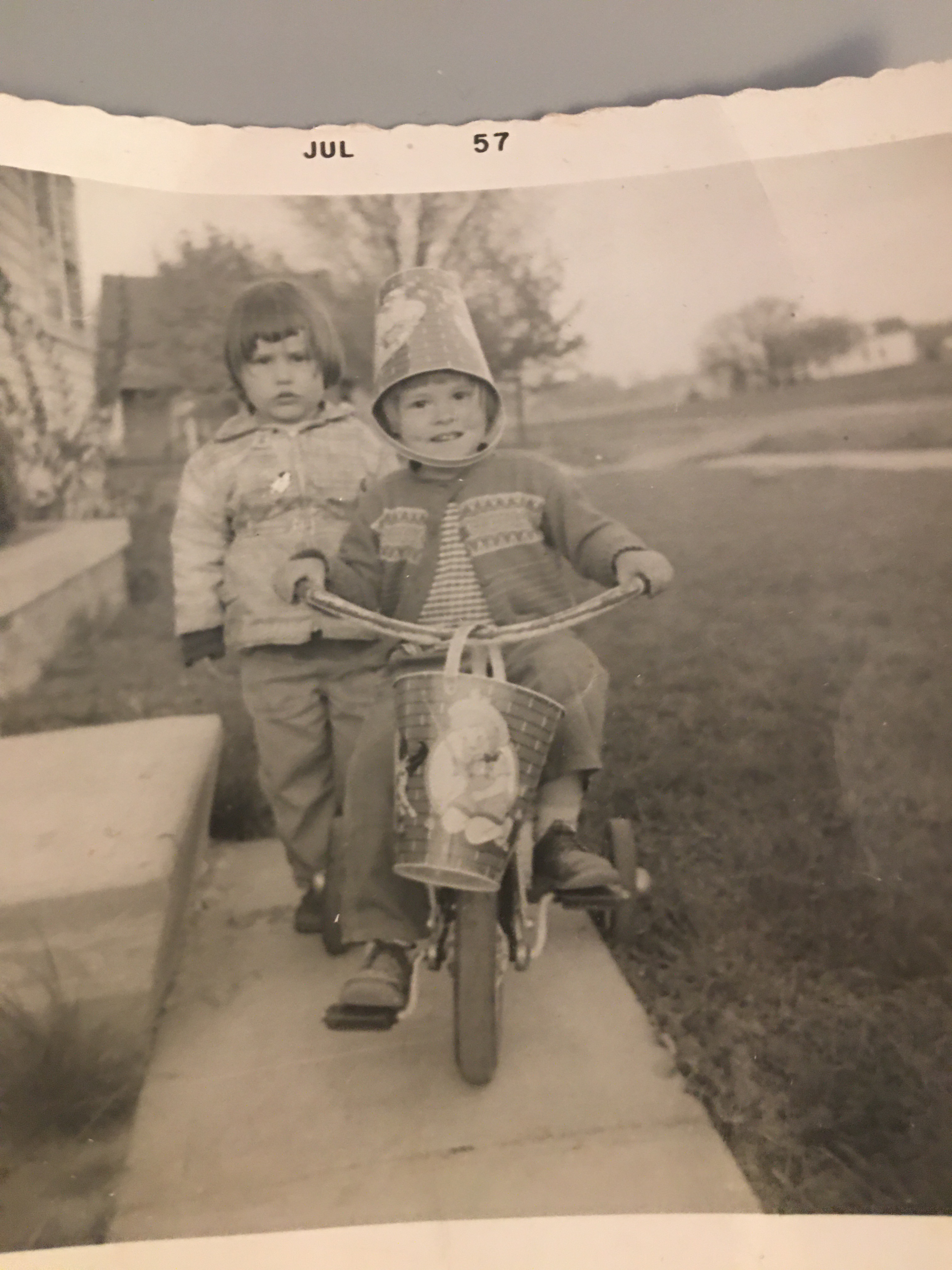
Recently, I undertook the task of sorting through a box of photographs, all black and white I might add, that spanned a lot of family history from my family. There were numerous photos of dad while serving in the Navy, poses of mom with us kids whether it was all three or as we joined the family. They also include those moments and memories when dad captured the antics created by us kids. While sorting and fingering these precious  memories I came across one that brought a big smile to my face and a chuckle in my throat. I found myself looking at myself, a photo taken in July 1957; I was four years old,  sitting on my tri- cycle wearing a metal sand bucket on my head. Standing next to me with a very serious look of scorn or sadness is Katie, my little playmate. She lived next door to us and was the youngest in her family.

We are both wearing warm coats so the weather must have been chilly that day. Not only am I wearing a bucket on my  head, but there’s another one swinging from the handlebars of the bike. Maybe that’s why Katie is sad? Did I not share the other bucket with her? Where’s her bike? Did we take turns riding the one that is shown in the picture? Though I don’t have the answers to these questions I can clearly recall that getting the handle of the bucket down below my chin was a tricky feat. The sturdy handle didn’t “give” way for the snug fit created by this original “look”, my little fingers tugging at it until I got it positioned under my small chin.

Katie and I were pretty tight. She had a hard time pronouncing my name, Susan or Susie, so hers came out as “tooey”….a nickname that stuck with me in the neighborhood and even mom who stretched it to “tooey pie” as a term of endearment. Because both Katie and I were the babies of our families, we often played by ourselves as our older siblings went off to other adventures that didn’t include two little sisters getting in the way. But this didn’t mean we weren’t capable of dreaming up our own shenanigans. Enter a new car and a big mud puddle.

It had rained during the night and a big wonderful mud puddle was formed next to the driveway at Katie’s house. She had an uncle who visited one day, driving his new car for all of her family to come out and admire. It was yellow, about the shade of a creamy homemade lemon pie. And it was parked right next to that mud puddle. At first it was fun to make mud pies with our tiny hands, patting them out flat as we flipped them back and forth between our palms, feeling the wet gooey dirt between our fingers. As much enjoyment and fun we got from forming and squishing the pies, our attention turned to the car and we had a lightbulb moment. What if our pies would stick to something? We carefully planted a pie on the side of the car and voila!–it not only stuck, it stayed in place and in a short while dried a bit, all the while staying in place on the car door and fender as we continued our mud pie display. We were SO proud of our artwork that we didn’t notice when the front door opened and her uncle appeared on the scene. I wish I could remember if he was angry, laughed, or reacted some other way but I don’t. All I can recall is that he asked us “what did you do!” Being the sweet little girls that we were we gave the only rational answer possible…”nothing”. Never mind that our hands, pant legs, and sleeves were covered in the undeniable evidence left from mud pie making turned into displays of art on a ready canvas. Never mind that as the pies dried out even longer, they eventually fell off the car leaving a faint circle outline on that beautiful creamy yellow backdrop.

I’m pretty sure we weren’t punished other than a verbal scolding. Katie’s uncle was left to the task of washing his car and at day’s end our mother’s would put us in a tub to soak away the mischief of the afternoon. It’s a great memory, but unlike wearing a bucket on my head, there’s no photo of the mud pie art display, only faltering details of a new car, a mud puddle and glorious opportunity with a partner in crime.

Heartache in the Neighborhood

Years have passed since we rode our bikes through my neighborhood of childhood that eventually ushered in teen years, high school graduations, college educations and launched fcareers and life as adults taking on the beauty and responsibilities of marriage and becoming parents of our own. This stage of my adult life includes a reflective mirror that allows glimpses back on those formative years that seemed so idyllic. And, though they were, holding onto the treasures and memories of bike rides, games of hide and seek, Halloween night escapades along with snowball fights and the building of forts, sorrow was not an unfamiliar guest.

We are standing outside the home of the G family, the ones who lived in the brick home, owner of the construction business. The years of long neck beer bottles being delivered to their home have taken on the reality that alcoholism exists in the lives of these wonderful friends and neighbors. It’s a truth that escaped my childhood innocence for many years. I wouldn’t come to recognize and understand for quite some time the devastation this disease’s toll can have on a person. While I never actually saw anyone in the family when they were drunk, I knew. Slowly, details of dysfunction emerged in the life of their oldest son, Gary. I would describe him as a “bad boy”, handsome, talented in many ways, but possessed a weakness towards alcohol and rebellion. Though our lives separated once high school graduation took place, I learned that after working with his younger brother in the family business for many years, he died. His body was destroyed by the effects of too much drinking. I can only imagine the mental anguish he endured that drove him to drown his problems in a glass of beer.

This same family had another son, Jeff. He came along late in life to Mrs. G. I can clearly remember him being born and becoming a delightful child. But, later as an adult, whatever tormented Jeff caused him to take his life. As if losing one child is certainly unbearable in my own imagination, I cannot fathom the loss of two.

We can wander now to the middle of the street, to the P family. Let me introduce you to them as I didn’t do so in the previous year’s bike tour. The P family had two daughters, both of them very pretty and fun to play with outside or with our Barbie dolls in the shade of a tree or garage. Mr. and Mrs. P were rather private people too. (I used to confuse private with being stern or mean)

Like the lost connections with the other kids of Zauel Street, I had no contact with the girls after moving away from home. I learned that the oldest daughter, Barb, had married and had a toddler son. She had a great job which involved the opportunity to travel. One of those business trips took her and her husband to Texas. I learned that before they left for the trip she insisted on creating a will and custody arrangements for their son in the event of death. This desire was scoffed at by her husband and I hold no fault for that. Don’t we all assume life will never be interrupted? But it was. Barb and her husband were in the back seat of a taxi one evening during the trip and they were rear ended in an accident. Barb did not come home on the plane alive. Her husband, her family, joined the group of despairing families who had suffered extreme loss.

Remember the home of Mrs. H? The mom who made donuts or other goodies for us kids? They, too, experienced the loss of a child. Not one, but over the course of a few years, two daughters. Tragically, one took her life and the other died several years ago of an illness. Intertwined with those losses was the suicide of a daughter who belonged to the oldest son, granddaughter to Mr. & Mrs. H. This past year, the surviving daughter of David died from a heart issue; she was only in her 30’s. 

Back at my own home, now empty of our memories with a new family living there, I am thinking of my oldest brother David. He often recalled how he helped our dad with the different phases of building the house which was completed in 1954. He’d smile when he told me about seeing me walk for the first time, getting up from sitting on a pile of hardwood flooring and taking off through the house that could be walked in a circle through the doors to each room. David left home in 1967 when he married. He didn’t move far from us so visits were frequent, especially when his three daughters had birthday celebrations or holidays rolled around. 

Dave was my buddy. Seven years older than me, we seldom argued. He tried to teach me euchre, let me borrow his baseball mitt (we were both left handed) and we shared a love for popcorn and homemade ice cream, both of which he would make without any extra pleading on my part. 

It’s hard to believe that  memories are from the 60’s, 70’s, 80’s, 90’s. Before we both realized it, we landed in the 2000’s. Gone were the frequent visits as miles were put between us by my family’s move from Saginaw in 1989. Phone visits kept us connected with a few family gatherings in the summer months. News came by phone two years ago that Dave was struggling physically and emotionally. After several misdiagnoses, Dave received the final report that he had a tumor on his brain. At first, surgery seemed an option, but the tumor had a mind of its own, growing fast, creating and solidifying that surgical intervention was not an option. Dave left the hospital and entered a care facility. As the tumor gained in strength, overpowering his ability to converse much, he had an increased need for pain medication. My last visit with him in person is one I will always cherish. He was in and out of coherence; I can still hear him saying “whoa” repeatedly. Then, and even now, I believe he was getting glimpses of heaven. We were able to exchange “I love yous” that day which became the last words he spoke to me. News of his death came several days later. At the very moment of leaving this life, Dave was reunited with our parents, grandparents, numerous uncles, aunts, and cousins.

While I have absolutely no doubt where my brother is spending eternity, I have to confess I hold a certain amount of fear for Gary. For Jeff. For Barb. Any time I rode my bike or took a walk in my neighborhood back in those years of childhood, I don’t remember any deep connection with God for those families. The immaturity of a child cannot comprehend such a disconnect. It’s now, as I reflect, as I write and describe what I can “see” and “remember” that this precious gift of salvation was not taught or modeled by their parents. Thankfully, the H family were faithful church attenders and opportunity for a relationship with God was most evident.

I haven’t thought a lot about all the families I grew up with as a child. Occasionally a memory will pop into my mind and float by as quickly as it came.When I do ponder the variety of memories and experiences, I can clearly see now that as a child I experienced life  wearing rose colored glasses and adorned myself with  trusting innocence. That was comfortable attire for a little girl born in 1953 who left home in 1974. Now, in 2021, having “lived life”, complete with my own measure of joy and sorrow, coming face to face with my own weaknesses, I am looking at those years with lens of discovery and reality of brokenness, gazing at imperfect people who did their best in the moment, in the years of successes and setbacks, and above all–great loss. Now that I have been able to measure and evaluate the influences from each family, mainly the adults at the time, on my life, I am thankful. I am grateful that in the midst of dysfunction, lack of faith for some, each family was respected, loved, accepted–even disciplined–I marvel at how so “many” different people could build a home, have a family, and create a beautiful, loud, crazy neighborhood that I loved to ride my bike through, stopping for a cold glass of Kool Aid or a P & B sandwich served on a paper plate from one of the “neighborhood moms”. 

Meet My Neighbors Part 2

Our pleasant bike ride that took us up and down Zauel Street has ended and now we will venture up Wheeler Street to introduce you to those families that were also part of my childhood and teen years. These memories are not as vivid as I realize now that the majority of my childhood friends did not live on this side of the neighborhood block. Nonetheless, there are some interesting people and characteristics that I’ve never forgotten all these 60 plus years later.

Our house faced Arthur Street; we lived on the southwest corner of Wheeler and Arthur. Behind us, butting up to our very narrow backyard, was the K family. They had five children, were Catholic and Mr. and Mrs. K became good friends with my parents. Mrs. K made the best grape Kool Aid on hot summer days (I think she doubled the amount of required sugar, thus making her recipe one of my favorites compared to the conservative method my mom followed) They had a large backyard, a big sandbox and lots of bikes to take turns riding. 

Next to them was a couple who lived by themselves until late in life they were blessed with a son, who ended up being their only child. I can’t remember their last name; I think it started with a G so that’s what I will call them. Mr. G was VERY particular about his lawn. He tended it carefully, kept it well fertilized, and manicured. Mr. and Mrs. G were rather gruff, and I remember being instructed very sternly by him “don’t walk or play on my lawn.” So, is it any wonder that whenever we dare so, we would plant our feet in his grass just to say we had defied his orders!

A few houses down was the W family. Mr. and Mrs. W were rather stern people too. They had a daughter and a son, both of whom I didn’t get well acquainted with until our teen years when high school classes brought us together as well as a small band (more on that later). A couple doors from them was the E family, dad, mom and two daughters. It just so happened that they were the family we shared a telephone party line with which caused trouble on occasion (they didn’t always do the polite thing and hang up immediately when lifting the receiver; we could hear them listening and breathing until we’d ask “please hang up”.) I played with the E girls occasionally as my mother wasn’t fond of their “language” at times, thus banning them from our yard or me from theirs.

Next door to the E family lived a single mom raising two boys. She was one of two such women on the street, a rarity in my childhood years. I remember including her oldest son in some of our playtimes with the Zauel gang. 

Back down the street and on the corner of Wheeler and Gilbert was the S family. They moved in and aroused our curiosities since they had four kids and became the “new family in the neighborhood”. Two sons were their older children, followed by two girls. They quickly fit right in with all the Zauel kids and soon became a favorites place to play in the summer because they put up a small pool. Theirs was the home where I learned that white bread torn in chunks to soak in Campbell’s tomato soup was a delicacy. 

Mrs. S could sometimes use language that would make a sailor blush. I can visualize her leaning on her kitchen counter, smoking her cigarette and talking to a girlfriend, cuss words flying left and right. After experiencing this display of colorful conversations she carried on for what seemed like hours, I recall going home and telling my mom “Mrs. S sure is angry a lot” and explained my reasoning when asked why was because of her wide range of swear words. Mom laughed a bit and told me “She’s not mad, that’s just her way of talking.” And mom was right, when I got in my teen years I realized she was one of the most loving women I’d ever meet. In fact, she was very generous too, beyond opening up her home for inside play dates and serving up a quick lunch. She was the “cool” mom who, on an early Saturday afternoon, piled a bunch of kids into her car and deliver us to the Court Street Theater for a double feature of scary movies. Since this was in the early 60s seatbelts weren’t required so I know we had kids on the seats with a few of us smaller ones on laps. She’d drop us at the curb and tell us where to be at the end of the second movie for the ride home, windows all open and us noisy kids telling her about the movies!

When I hit my teen years of high school, Mike S., who was an avid drummer put together a small band. He asked me to join as a vocalist, along with Greg W., a guitarist he knew named Bob (he was really cute and eventually became a boyfriend for awhile) , my best friend at the time, Luann, and our manager was a good friend to Bob (can’t remember his name). Mrs. S let us practice in their home and never complained about the racket we made. We were lucky to get a couple of gigs and thought we “had arrived”. But, gigs come and go and so did our little band, but not without leaving behind some great times together!

In the middle of the block across from grouchy Mr. and Mrs. G was another family, Mrs. W and her children. She was a single mom too. She kept to herself and anytime I played with her daughters, it was in our yard. She had an older son who everyone liked; he served in the Army and during the Viet Nam War was killed. But that wasn’t her only heartache and tragedy. One summer night a couple police cars pulled up to her home and the officers lingered for a long time, going in and out of the house, carrying stuff, checking the trash can on the curbside for pickup. Soon, neighbors were coming outside to stand along the edges of our yards, wondering and speculating what the fuss was about. I remember standing on our front lawn, my mother beside me, and we too pondered the situation. I don’t remember if it was hours later that hot summer evening or a few days into the week when we found out that Mrs. W had birthed a child and whether she harmed the baby herself or something accidental happened, she had disposed of the tiny infant in the trash but her attempt to self protect was found out….I can still hear my mom, upon learning of the facts, told me that Mrs. W must have been in a very bad situation and it wasn’t our place to judge her, but to love and give her grace. It’s a lesson attached to a very vivid memory which has become foundational to my understanding of grace.

On the corner was the R family. They had two boys who were quite rambunctious and caused my dad a lot of scratching his head. Dad would often tell people he’d never forget seeing Terry on the roof of their home literally swinging from the rods of the TV antennae. Before storm sewers were put on our road, it was Terry who would sit on the drain to stop heavy rain water from escaping the curbed lined streets, so us other kids could wade, splash and ride bikes through the deep water.

Perhaps the last family to describe from my childhood memories is the R family who eventually came to build a home across the street from ours. Mr. R farmed the land along Arthur Street. He grew corn, wheat, and sugar beets. He and his wife had three children, all older than me so their boys were someone my brothers would “hang out” with and Mr. R also hired my brothers to be “water boys” for the migrant workers who came in during harvest time. Mr. R was a big, tall man with a huge smile and a matching belly laugh with nary a mean bone in his body until us kids would play in his wheat, knocking it down as we used it to create imaginary castles and forts. His youngest son Tom was a lot like his dad, all fun, always up to a challenge. In the aftermath of a snowstorm one winter, where we got over several feet of snow, it was Tom who decided he’d clear the road with a family car. Somehow, he managed to drive the car down the street a ways, rev the engine and drive at full speed right into a mound of unplowed snow where he promptly stayed stuck for awhile, giving all us neighbors a good hearty laugh and another person to dig out of the deep snow.

These families, along with all the others on Zauel Street, made up my childhood. Farming ended for Mr. R when I was yet in grade school, walking the two blocks to our new building that I attended from second grade until sixth. He sold his land to a private club who created a beautiful golf course and dining facility where corn and wheat used to cover the rich soil. Another developer turned the curbside portions of ditch and weeds into buildable lots and a variety of houses were erected in a matter of months, allowing countless families to join our merry band of kids riding bikes, tossing Frisbees, flying kites, and creating all kinds of snow forts. We all grew up, graduated high school, went off to college or the workplace. 

Everyone is gone. The years have taken parents to eternal resting places. Whenever I visit the “old” neighborhood, I can see faces, smell the kitchen aromas through open windows, hear the laughter and arguments typical of childhood play and growing relationships. The families are gone though the homes remain. The memories have faded but the feelings of love, acceptance, and adventure still linger, all worthy to be recorded and share with you as we park our bikes after enjoying this last adventure together, this trip around a city block that was home to a wide variety of families who will forever remain in my heart, soul and mind.