
Leftovers.
Thanksgiving 2025 is behind us now. Remnants of family dinners together linger in the form of uneaten turkey or other meats, scrapings of mashed potatoes stuck to serving bowls along with other delicious side dishes we all typically enjoy on this holiday that brings family and friends together around food laden tables.
Leftovers. What to do with all the food that didn’t get eaten? Maybe as the host you fill take out containers or zip lock bags with whatever you can pawn off, saving room in your own fridge for the remainder. Or, if waste doesn’t concern you, unused portions are easily tossed in trash bags that will make it to the curb on your next pickup day.
Leftovers create two camps. One, is made up of those who absolutely love having extra food on hand for a few days, thus alleviating the need to prepare fresh meals. The second is folks who don’t enjoy dealing with the quantity of food that leftovers creates, out of sight, out of mind.
Thinking about leftovers has me reflecting on a time in Jesus’ ministry where leftovers didn’t happen because of an ordinary meal. Rather, an ample amount of leftovers actually occurred from two separate miracles involving a mere loaves of bread and two small fish from a day’s catch.
In Matthew 15, he records about the afternoon that Jesus fed 4,000 people, using seven loaves of bread and a few small fish. Before the meal was given to the people, Jesus gave thanks for the provision. Then, the disciples distributed the food.
In Luke 9 he wrote about Jesus feeding 5,000 people using five loaves of bread and two fish. Again, before the meal was given, Jesus gave thanks as He looked up to heaven.
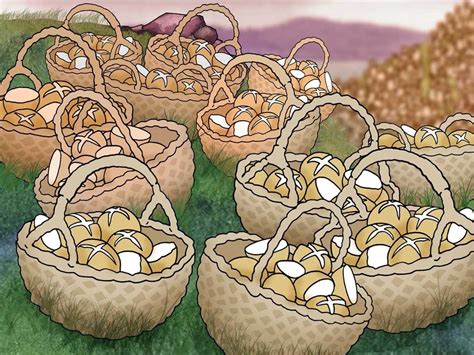
It’s worthy to note that in both scenes, although we are told 4,000 and 5,000 dined, the numbers were most certainly larger as women and children may not have been counted in the attendance figures. Also–and I believe most worthy to note–is that in Matthew’s account we are told the disciples filled seven baskets with leftovers. In Luke’s account, the guys filled 12 baskets.
Leftovers. Only these were of a different variety than the turkey carcasses and mashed potatoes scrapings we manage today. These leftovers had been blessed by the Master’s own hands and although considered as remainders of a meal, all words of thanksgiving and blessing lingered in permanency.
I find–in curiosity and amazement as I read these accounts–that Jesus not only fed hungry bellies, He allowed there to be leftovers. I have to ask myself “why”? What was His purpose?
I think He did this to extend the astonishment of the miracle. I also think He was continuing to show His disciples the level of power He possessed to turn ordinary things into something of great benefit. In these circumstances, He and the disciples were faced with thousands of hungry families and by using a very small amount of food–insurmountable odds by human measure–He satisfied empty stomachs and opened spiritually empty hearts and eyes to the glory and wonder of God!
Digging deeper into the meaning of our 7 and 12 baskets of leftovers has significance, too. In Hebrew the number 7 represents completion, perfection, and divine intervention. The number 12 refers to a perfect government. God established 12 tribes in Israel. The gates and foundations of the New Jerusalem number as 12, and Jesus chose 12 disciples which revealed the rule and authority of Himself.
Pretty interesting leftovers. Even in what may be considered as food suitable for a takeout container or filling a trash bag by today’s measure, Jesus used the opportunity to teach further lessons beyond the mere satisfaction of a full belly.
Another interesting phrase–and don’t miss this–as Jesus took the bread to feed the multitudes, along with giving thanks He “broke” it while praying. Where do we see this again in His ministry? At the last supper with His disciples. “He took bread, gave thanks, and broke it….”
What do you think went through their minds as He spoke these words during a passover meal with them? Do you think they had an a-ha moment? Hey, remember when He did the same thing a short while back with some bread and fish? Human nature tells me they most certainly recalled those miracles. Were they able to also remember when Jesus described Himself “as the bread of life”?
Certainly, they would face a near future reality that His body would literally be “broken” as He hung on a Roman cross.
Leftovers. I hope you won’t think of them the same way anymore. I hope you’ll fill takeout containers with excess food and share with someone who needs a bit extra between paychecks. When you sit down to a meal, I hope you remember to first give thanks. You don’t necessarily need to “look up to heaven”, although it’d be a beautiful act of worship if you did, but assuming a posture of gratitude for provision and abundance reflects a satisfied heart. And a full belly.


 susantrinitysite's Blog